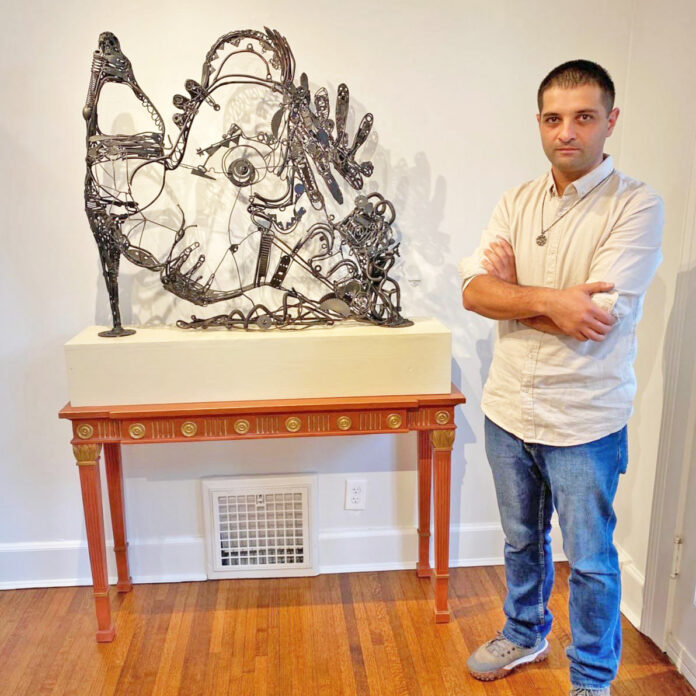
Abstract Love, #6, Metal and the artist (Photos by Marc Barker)
Plea to Stop Genocide Falls on Deaf Ears in ‘Homo Politicus’
by Muriel Mirak-Weissbach
OKLAHOMA CITY, OK, FEBRUARY 19, 2026 — “Art lovers from the region attended and, through my work, many of them discovered Armenia for the first time!” This is how Arman Hambardzumyan described the response he received at his solo exhibition in Oklahoma City not long ago. Billed as “acclaimed artist, ArmanH” by the 1515 Lincoln Gallery, which hosted the event, the exhibition took place October 16-November 29 and was divided into two parts. The main hall was curated by John Wolfe and featured artists from the U.S., Canada, and Europe, whose works were united under the concept of Geometrics. “The second hall was dedicated entirely to my work, where I presented 11 sculptures,” Hambardzumyan — or better, ArmanH, as his American hosts called him — explained in an interview with the Armenian Mirror-Spectator on February 14. “The solo exhibition brought together several thematic directions: my Abstract Love metal sculpture series; bronze works inspired by ancient heroes, including Battle Against the Minotaur and Pharaoh; a series of mixed-media sculptures depicting the female nude; and animalistic sculptures in which I combined metal with native Armenian stones,” he said.
The 1515 Lincoln Gallery offered art lovers a unique chance to look beyond the works into the mind and creative activity of the artist himself. In a talk on October 18, guests were able to participate in an interactive event with Hambardzumyan. While starting from scratch on a new work, the young sculptor talked about himself, sharing the story of his background. Aided by a PowerPoint presentation and slideshow, he illustrated the creative journey he made to become an artist. Born in 1988 amid war and hardship in Armenia, he found refuge in art and determined at an early age to become an artist, fulfilling the unrealized dream of his father. He studied at the Henrik Igityan National Centre of Aesthetics (2000-2005) and received his B.A. and M.A. from Yerevan Pedagogical University (2009, 2011) where he developed a mastery of diverse materials, ranging from bronze to objects he found by chance, creating works that bridge history, myth, and modern life.
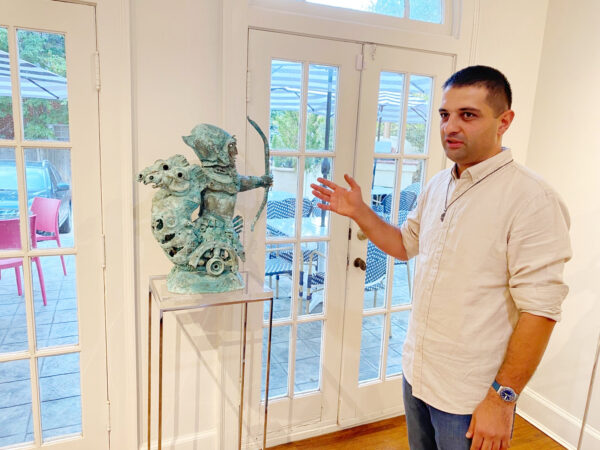
Arman Hambardzumyan with his sculpture Pharaoh, bronze (1) (Photos by Marc Barker)
He has explored in depth the world of myths, especially those in Homer’s epics The Odyssey and The Iliad and studied the works of German archaeologist Heinrich Schliemann (1822-1890), as well as related artworks. His sculptures depict battle scenes and mythological heroes that originate in episodes of the Homeric texts, but they also evoke reflections on violence in the contemporary world; when war broke out in 2020 in Artsakh (Karabakh), he turned to sculptures inspired by ancient Greece to express his pain and condemnation of war waged against modern Armenia.
The idea of organizing a workshop at the 1515 Lincoln Gallery, he said, came from the gallerist, Susan McCalmont. “It proved to be an excellent initiative, as the workshop allowed for a deeper understanding of my artistic process,” he added. He opened the workshop by saying that his sculptures were fundamentally based on the line, that is, on a linear image: “Through the sketches I created during the workshop, viewers were able to see how three-dimensional forms emerge from graphic structures The process helped them understand how the drawn line is transformed into a sculptural form.”
Local artists attending were particularly intrigued by his technique and the equipment he uses. He recalled that they “expressed appreciation for my ability to work with metal,” in particular.
But their interest was not limited to art. Following his talk, he received many questions about his country and nationality. In response, he presented a brief overview of Armenia’s history — from its ancient kingdoms (Urartian, Ervanduni, Artaxiad, Arsacid, Bagratid and the Cilician Kingdom) to the 20th century, including the First Republic of Armenia, Soviet Armenia, and the Third Republic. “I also spoke about Armenia’s early adoption of Christianity,” he explained, “its distinctive architectural heritage, the ancient tradition of Armenian winemaking, and elements of our national cuisine. In addition, I addressed the tragic events of the 20th and 21st centuries – to show a nation that had not yet fully recovered from the trauma of the 1915 Genocide.”
Throughout the exhibition, there was a strong desire for dialogue and connection. Many visitors and fellow artists wished to meet with him personally, visit museums together, and continue conversations over lunch, engaging in meaningful and fruitful discussions.
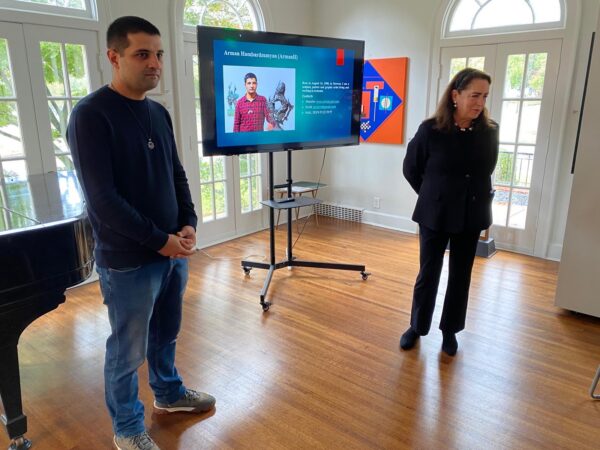
Solo Artist Talk at 1515 Lincoln Gallery, the artist with Gallery owner Susan McCalmont (Photos by Marc Barker)
Two Views of America
This was not the first time that Hambardzumyan had visited the U.S. In 2017, he took part in the New York City Art Expo. His observations on the differences between the two visits are telling. “Comparing my first and second visits — New York and Oklahoma City — I experienced two completely different Americas. New York, as a typical megapolis of megacities, inspired me immensely. The dynamic rhythm, architecture, and urban energy deeply influenced me, and it was there that I began my Abstract Love artwork series, drawing inspiration directly from the spirit of the city.”
Eight years later, he discovered another America: “Oklahoma, by contrast, felt more conservative, with a strong presence of local traditions. Thirty-nine Native American tribes live there, and their cultural influence is deeply rooted in the region. Known as ‘the land of cowboys,’ Oklahoma offered a different yet equally meaningful artistic discovery. I explored unique museums representing local art traditions alongside contemporary art. In Oklahoma City, I visited a district called Phaseo, an area filled with galleries and artist studios. There, I discovered many talented local artists and learned a lot, especially about printmaking and glass art. The city is truly rich in artistic talent. Together with John Wolfe, another artist from Geometrics, I created some graphics with pen and paper in his studio.”
His collaboration with 1515 Lincoln Gallery (formerly Objects Trouvés), a gallery dedicated to European artists and to promoting their work within the American art market, began in 2021 and it was gallery owner McCalmont who invited him to present a solo exhibition and who personally organized all the preparations for its realization.
“I would like to thank Susan McCalmont, all the gallery staff, Marc Barker, with whom I traveled extensively, and Elisabeth and Peter for their warm welcome and hospitality. Thanks to them, I will always remember my first solo exhibition in the U.S. with deep gratitude.”