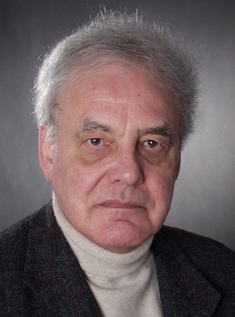
Wolfgang Gust
In Memoriam: Wolfgang Gust, Noted German Scholar of Armenian Genocide
by Muriel Mirak-Weissbach
The German journalist, genocide researcher, author, and valued friend Wolfgang Gust died peacefully on June 9, 2026, surrounded by his family at his home in Hamburg. He was 91. He embodied a rare combination of intellectual curiosity and rigor with a compassionate commitment to historical truth and justice. With the fruits of decades-long research conducted together with his wife Sigrid, he educated specialists as well as the general public and contributed decisively to the 2016 recognition of the Armenian Genocide by the German Bundestag (Parliament).
He was born on April 9, 1935, in Hanover, just two years after Hitler’s seizure of power and grew up during the traumatic period of World War II, his city ravaged by extensive bombardments. On completion of his secondary education, Wolfgang, who was an exceptional athlete, decided against a career in professional sports, and entered university. He studied Business Administration in Bonn and Hamburg, then Romance Languages and Culture (Romanistik) in Freiburg and Toulouse (France).
In 1965, he joined the Paris office of Der Spiegel, Germany’s leading news magazine, first at the Economics Desk then, in 1970, as Chief Correspondent in Paris, and in 1977, Foreign News Editor in Hamburg. Beginning in 1980 he was director of the Spiegel Book department for its duration, and in 1993 entered early retirement to pursue activity as an independent journalist, researcher, and author.
In Gust’s own account, he happened upon the story of the Armenian Genocide by pure chance. While in France in the late 1980s, he read Le ciel était noir sur l’Euphrat by Jacques der Alexanian (1988), a book about the horrors of persecution something he had encountered in Holocaust literature but here, for the first time, it was about an Armenian. When he searched for secondary source material on the genocide, he found some post-1918 German works, but almost nothing published after 1945.
On the basis of what material he did find, he authored a series of three articles in Der Spiegel in 1992 that dealt with the Karabakh (Artsakh) conflict and Armenian Genocide. In the following year he published Der Völkermord an den Armeniern. Die Tragödie des ältesten Christenvolks der Welt (The Armenian Genocide: The Tragedy of the Oldest Christian People in the World). With this first book he sought to use his journalistic skills to introduce a broad readership to the results of available studies in modern European languages.
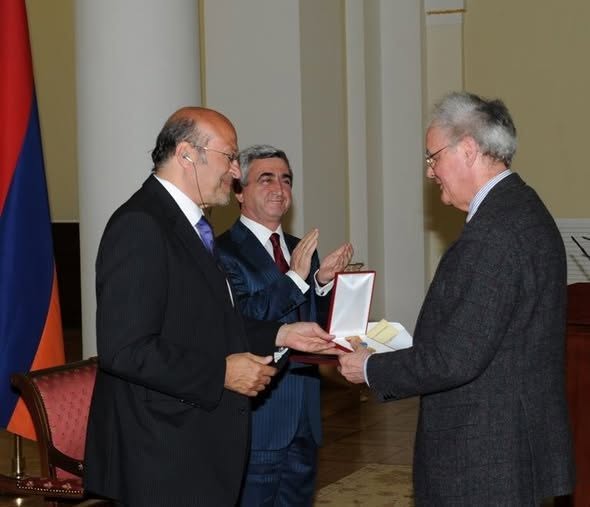
Wolfgang Gust, right, receives an award from President Serge Sargsyan, center, in 2017.
Work on primary sources came later; together with his wife, Sigrid, he spent years copying the original German diplomatic correspondence from government archives during the genocide. Titled Der Völkermord an den Armeniern 1915/16. Dokumente aus dem politischen Archiv des deutschen Auswärtigen Amts (The Armenian Genocide 1915/1916. Documents from the Political Archive of the German Foreign Office), it would appear later in Turkish (2012) and English (2014). This voluminous work required meticulous, time-consuming work, including deciphering handwritten Imperial-era cursive script (Süttelin), a task that his dedicated wife accomplished until serious illness forced her to pause. With a website www.armenocide.net, the Gusts made this rich primary source material available to researchers as well as the general public.
During his decades-long involvement with Armenian history, Wolfgang Gust never sought academic or personal reward, although he received the AGBU Garbis Papazian Award (2006) as well as the Special Prize of the President of the Republic of Armenia (2012). What motivated him was a search for truth, especially regarding a crucial chapter in the modern history of his native Germany, and he never shied away from controversy. At the same time, if shown to be mistaken, he would readily acknowledge and correct his errors.
Wolfgang welcomed an exchange of ideas with anyone desiring to learn. He offered informed insights to fellow researchers and students, but also to artists, writers, and actors dealing with Armenian themes. His work has made a special impact on intellectuals of Turkish background, be it genocide historian Taner Akçam, publisher Ragıp Zarakolu, who was involved in the Turkish edition of Gust’s archive research, playwright Dogan Akhanlı, or filmmaker Fatih Akın. Artists have come to him not only for factual material, but for insight into understanding the human dimension of the genocide. He also lent his time and efforts to provide intellectual and moral support to civil society initiatives aimed at bringing together Germans, Armenians, and Turks who were committed to working through their overlapping histories, in the search for recognition and reconciliation.
Wolfgang and his beloved wife Sigrid, a prominent lawyer, shared a special relationship. In 65 years of marriage, they pursued successful careers, while combining their efforts in the archives. Anyone involved in genocide research knows this is an arduous task, a challenge to endurance physically and intellectually. Together they have devoted themselves to the task.
At the same time, they raised a family, in France and then in Germany. When the children were growing up, they learned a great deal from their parents, and not only about the Armenians. Son Matthias recalls how his father, a “walking encyclopedia,” would tell them such captivating stories that they were stimulated to learn more about history and politics. In later years, Wolfgang would look forward with similar excitement to visits from his sons and relished in discussion with them. Visits from the four grandchildren were a source of delight, the garden a place for quiet relaxation. And Wolfgang always maintained a passion for sports, following soccer with keen interest.
We extend our deepest condolences to his devoted wife Sigrid, sons Matthias, Oliver, Bertold and their families. We are grateful to have had the good fortune to know Wolfgang Gust and his family.