


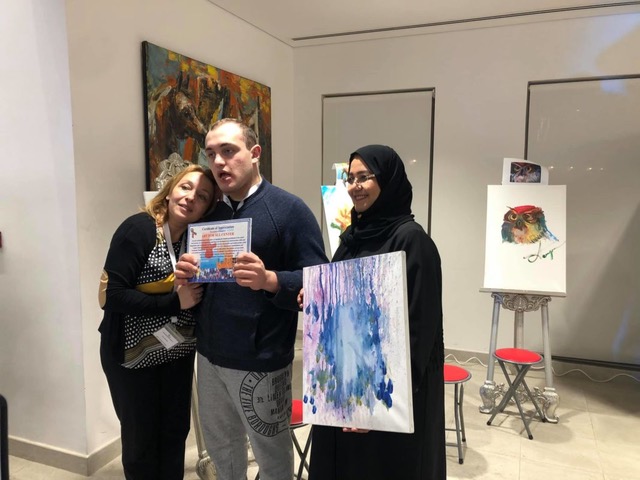
Sona Petrosyan and son Raphael Martirosyan from My Way, at Art for All Center with Ms. Mona Abdul Karim, SCHS Director, holding painting by My Way student Eva Ghazanchyan (All photos courtesy of My Way.)
Armenians, Autism and the Emirates
by Muriel Mirak-WeissbachYEREVAN — It was February 17 in Zvartnots airport, and two young men shared the stool at the red piano and played with energy and passion. It was before the Coronavirus pandemic had brought international travel to a halt, and they were expressing their excitement about their imminent flight.
Raphael Martirosyan and Vardan Ayvazyan were among the six students who were travelling with their mothers to Sharjah in the United Arab Emirates for a three-day stay. The students came from Armenian centers for people with disabilities: the Autism National Foundation’s My Way Educational, Rehabilitation and Vocational Training Day Care Center for Children and Teenagers with Autism, and the Yerevan My Love Foundation’s Louse’ Center for Special Needs Children. The visit took place from February 17-20, and offered the Armenian guests the opportunity to visit facilities of the Sharjah City for Humanitarian Services (SCHS), their host.
The SCHS is an independent organization in the Emirate of Sharjah dedicated to providing care for people with disabilities in the UAE. The Director General of the SCHS is Sheikha Jameela Al Qasimi, a person of exceptional capabilities and commitment.
The invitation came at the end of last year, on the occasion of the UAE’s National Day (December 2, 2019), and in the framework of the Year of Tolerance. Upon the initiative of Mohamed Al Zaabi, UAE Ambassador to Armenia, and with the support of Emirate companies in Armenia (Fly Dubai, AirArabia airlines, Carrefour Armenia, Euromotors CJSC, Garden 5, Leaves Garden, Al Khazna Farms and Bainouna International), six students from Armenia were awarded the visit, three from each center.
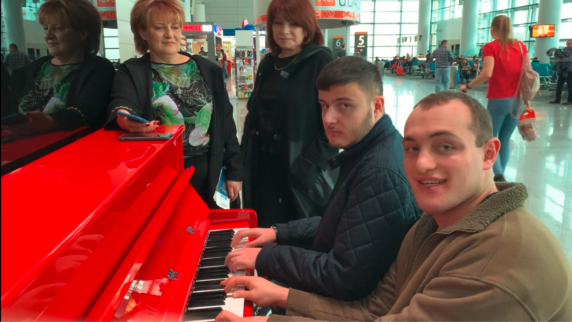
A musical sendoff at the airport
Following joint preparatory work with the facilities’ management and the Embassy’s specialists, a program was defined to provide both guests and hosts the opportunity to engage in fruitful exchange, comparing their experiences and approaches, to the benefit of the youngsters as well as their parents. From the Louse’ Center were Kristine Hambardzumyan and her son Gor, Maro Avetisyan and her son Sargis Nalbandyan and Gayane Melkonyan and her son David Baghramyan. From My Way, there was Board Member Mariam Ginosyan and her son Vardan Ayvazyan, Board Member Sona Petrosyan and her son Raphael Martirosyan and Marine Maleryan and her son Gagik Galustov. Two caregivers, Marine Torosyan and Teymine Balinyan, and two specialists from My Way were added to the group, thanks to the support of the ANF, the Embassy and the host organization. The specialists were Suzanna Petrosyan and Narine Vardanyan, managers of the Vocational Training Program and the Early Integration Program, respectively.
The SCHS was founded in 1979 as a branch of the Arab Family Organization in the Gulf region. In 1995 it became an independent organization in Sharjah, with a vast array of facilities designed to develop and educate people with intellectual and physical disabilities. Its director is Mona Abdul Karim. The Armenian delegation had the opportunity to visit and take part in activities at the three main centers. The first was the Art for All Center, whose motto is, “Art is a global language.” My Way also places great emphasis on the therapeutic power of art, so the exchange was based on shared, though different, experiences in creative endeavors. A tour and power point presentation illustrated the approach and experience in Sharjah; turning from theory to practice, the mothers and students took up brushes and painted. Working on canvases, the mothers had various flowers and an owl as subjects for their renderings. An art therapist helped out with color selection and mixing the paints. In parallel the students were working in another studio, coloring ceramic jars, while three other mothers worked with caregivers to prepare natural aromatic means to place in the jars. In addition to instruction in the plastic arts, the center offers performing arts, and the guests joined in the dancing.
The Al Wafa School for Capacity Development, which they visited on Day 2, is an affiliate of SCHS, which organizes information campaigns to raise awareness of mental disabilities and the means to deal with them. The school provides education for children with intellectual disabilities between the ages of 5 and 16. At Al Wafa, the Armenians joined in everywhere, taking part in outdoor activities, including sports and games, and indoor activities. Here music played an important role, and both the local students and the visitors performed songs and instrumental pieces (piano). The center has indoor facilities for games and sports, a rest area, sensory rooms and classrooms, including one dedicated to cooking. Here the visiting mothers joined with mothers of the local students in a workshop, in which they prepared dishes from the Arab and Armenian traditional cuisines. It was described as “exemplary teamwork” which culminated in “a tasty experience.” The mothers of Al Wafa students prepared a memorable surprise for the Armenian visitors — photo opportunities in national bridal dress, according to ancient Arab tradition — and handmade straw fans as souvenirs.
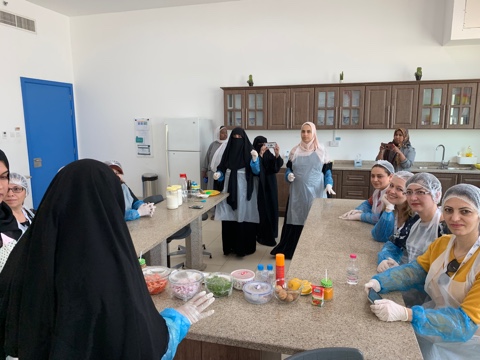
Mothers in dialogue about national cuisines
The third facility, visited on Day 3, is the Al Masarat Center for Development and Empowerment, which conducts music therapy classes, education in crafts and vocational training. During their visit, the students and their mothers engaged in the process of crafting decorative mosaic frames with the use of various items such as pieces of colored glass. The size of the frame and the artist’s imagination were the only limiting factors determining the final product. Amazingly beautiful items produced by the center’s students were on display. In fact, the Al Masarat Center has a gallery where art works done by the students during the academic year are presented in exhibitions. The visiting students received souvenirs made by the center’ students, ready frames, handmade metal bracelets and unique metal bookmarks.
Then they all boarded a bus for a tour of the city, and in the evening, before sunset, enjoyed an Al Qasba Canal boat tour. The visitors from Yerevan were also treated to tours of the Rain Room and the Aquarium.
In appreciation, the My Way center presented their Sharjah hosts with certificates of appreciation; to the SCHS “for the invaluable input, ongoing efforts and competent approach in the sphere of providing services for children with intellectual disabilities and autistic spectrum disorders, for the warmest welcome and precious and useful pastime….” To the Embassy of the UAE in Armenia, My Way expressed its appreciation “for the long-term fruitful cooperation with Autism National Fund Armenia, for the pro-active support of its initiatives” and especially for making it possible for students and their mothers to visit the UAE, a “unique opportunity” to have such an informative and precious experience.
The hospitality extended to the Armenians was beyond all expectations, and the level of mutual understanding, despite the cultural differences, was profound, especially among the mothers. As Sona Petrosyan from My Way summed it up, “All the mothers of children with disabilities speak the same language of love, dedication, devotion, they share the same concerns and pray for the same thing—for the health and progress of their children, for a secure future for all children with special needs, for making the world a better place for them, for tolerance and acceptance, love and opportunity.”
(All photos courtesy of My Way.)
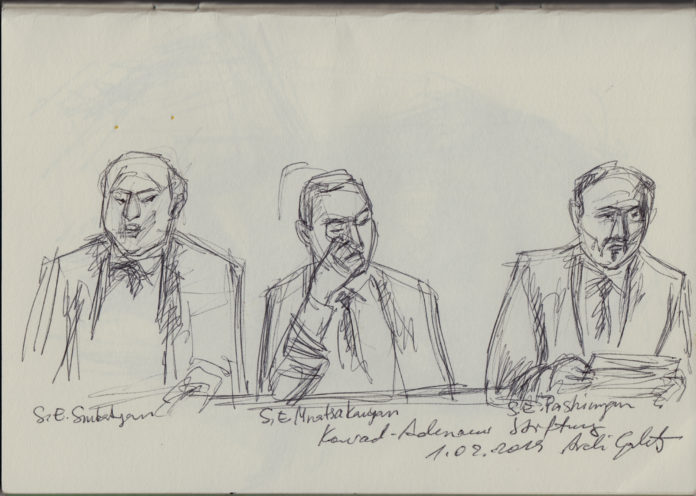
The Debate about Culture and the Culture of Debate
By Archi GalentzBERLIN — The website of Aravot reported on February 21 on the visit of Anna Hakobyan, the wife of Armenian Prime Minister Nikol Pashinyan, to Switzerland and the surprise that she brought with her. The surprise was her declaration that Armenia would once again amaze the whole world, this time with post-revolutionary achievements. Armenia is to become one of the most prosperous nations in the world, absolutely comparable to Switzerland Hakobyan supported Pashinyan during the revolution not only visibly and with extensive media coverage, but she is also now leading several charity organizations and is assuming serious representational duties.
Prime Minister Nikol Pashinyan himself, during a meeting at the beginning of February with parliamentarians and the business community in the Konrad Adenauer Foundation in Berlin, emphasized the fact that Armenia is not only a country with mining and agriculture, but a land of intellectuals, physicists, a flourishing IT sector and, as a member of the Eurasian Economic Union, a country that may also pave the way to access to a market of 160 million people.
And when asked about the planned elimination of the Culture and Diaspora Ministries, which has generated concern, Pashinyan responded that every government mechanism has a tendency towards excessive control and this could have a negative impact on business.
Proponents of streamlining the government apparatus stress that reforms do not entail neglect of spheres of responsibility. Armenia’s desire to introduce new standards of efficiency and its search for new models is also apparent in the cultural realm. In mid-May at the Venice Biennale 2019 we will be in a position to judge whether or not Armenia’s pavilion, which according to the exhibition’s curator Susanna Gjulamiryan this time is not to be organized on the premises of the Mekhitarists, will be convincing. Exhibition space at the Biennale is extremely expensive, but it is reportedly the explicit desire of the government-aligned commissar of the exhibit to invest considerably more than the usual $5,000 in the “Olympic Games of Art.” The Venice Biennale is the most important exhibition worldwide for contemporary art and architecture. It is particularly important to note that at this periodic event one cannot hide behind tradition and history, because its compulsory thematic focus concentrates on the “Now” – the current condition of the nation’s art and its cultural policy. Armenia has been an active participant since 1995 and in 2015 received the highest award, the “Golden Lion,” for its national pavilion. The 2017 presentation displayed very disturbing tendencies, and now what is being prepared is a huge installation of multiple interrelated components with a lot of videos which are supposed to provide a critical view of the “Velvet Revolution,” how it unfolded and what expectations it raised.
The Biennale should not be considered only an important display that mobilizes national resources for the outside world, since it is actually culture and religion together which constitute the main pillars of the national identity. Such a project has an impact domestically as well. And at home it is still the government restructuring that is shaping discussion in the cultural realm. As mentioned earlier, the elimination of a ministry does not yet mean that
The associated tasks will not receive adequate consideration, but the fact that the Agency for the Protection of Historical Monuments, which has been successfully managed by the Culture Ministry since the 1970s, is now to be placed under the City Development Agency is cause for justified concern. A conflict of interest is effectively guaranteed in this arrangement, and monuments, for example, the last remaining nineteenth-century city villas in Yerevan, might fall victim to the powerful construction industry.
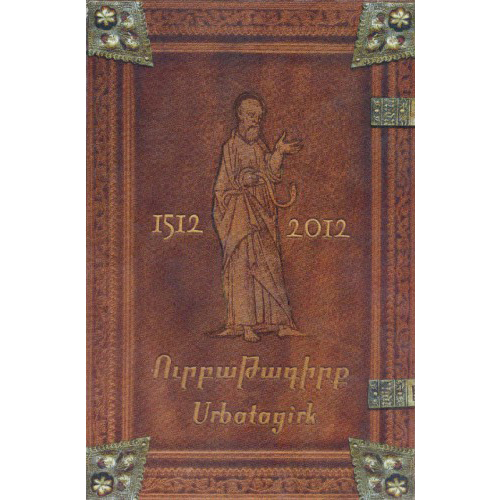
Urbatagirq
Another idea that is being hotly debated is the proposal to take paintings and other cultural artefacts out of museums and into schools where they can be exhibited. “Your Art” is supposed to be the name of the program, which is to implement what the current prime minister announced during his meeting in the Philharmonic Hall with people from Yerevan’s cultural scene in May 2018.
Pashinyan expressed his gratitude to the intellectuals for having mobilized the population to take to the streets, and then promised to bring the population to the same level as the intellectuals. In point of fact, the idea for “Your Art” is said to originate from Pashinyan. But the intellectuals responded only with concern, and even the offer to make more vehicles available to transport the paintings and to entrust the most valuable items to the security services did little to reassure them.
Armenia, though the smallest of the 15 republics of the USSR, possessed the third largest collection of art treasures in the picture galleries and even today there are astounding collections found in provincial cities like Dilijan or Vanadzor.
“Stupidity” – that is the name for this popularizing campaign suggested by Zaven Sargisyan, director of the Paradjanov Museum, one of the most successful museums in Yerevan, which not only earns its own money, but also supports a lively international program with exhibits recently in Berlin and Istanbul.
“Absurd! We have museums precisely for this reason: so that people go to the paintings and look at them, and not the other way around! Meaningless and unprofessional,” complained an angry Hayk Hovhannisyan on his site in the social networks. In Germany, he is the director of a highly respected restoration studio and has actively supported Armenian institutions for years. Anthropologist Gayane Shagoyan also hopes that Pashinyan, who has often proven willing to change his mind, will do so again, and cancel the “museum delivery service” program.
The Culture Ministry is to be subordinate to the Education Ministry and “Your Art,” regardless of the form it is to take, is clearly a project for education. It will not guarantee the continuing expansion of museum collections, it will not serve the aims of research into art objects and it will expose museum pieces to ever greater dangers, since for example any abrupt change in temperature and humidity, usually accompanying transportation, is simply catastrophic for paintings.
What is still more disturbing is the fact that there exists no museum law in the Republic of Armenia. And the museums, with few exceptions, are state run and therefore are regulated by orders from above. Even during the time of the previous government, for an exhibition abroad the director of Armenia’s National Library had to take the first edition of the Urbatagirq, the first book printed in Armenian (in 1512), and which exists in very few copies, and wrap it up in a piece of cloth and tuck it into his inside jacket pocket to transport it. There were written instructions from President Sargsyan, but no funds for transportation or insurance had been authorized. In the exhibition titled “The Art of Calligraphy and the Charm of Pictures,” which was presented in Halle an der Saale on the 500th anniversary of book printing, this priceless item was exhibited like a relic, under protective glass in accordance with museum practice, only to be tucked again into the inside pocket of the director (who did his best not to perspire) for the journey home.
It is well known that hope is the last to die. The website of the Moscow-based Armenian Museum of Moscow and National Culture reported on February 25 on two museums in Yerevan that have been begging to be renovated for almost 40 years. It is not a question of cosmetic appearance but of mold that has attacked the foundation masonry, the wooden floor and a number of exhibits.
The reference is to a house in Yerevan’s city center, with two important institutions, one on top of the other. One is the atelier of Ara Sargsyan, a sculptor originally from Istanbul who studied in Vienna and was close to the Nemesis Group; and the second is the museum of the painter and graphic artist Hakob Kodjoyan, who studied in Munich and was among the founders of the national painting style. The report is alarming, but it does contain some hope in that it mentions a law project that is still in the advisory stage. In the project, museums are to be allowed to run cafés to earn income to finance the renovation of the exhibition rooms. Apparently it is believed that restaurants in museums might expect adequate turnover. In fact, those few museums in Armenia that offer visitors postcards and other memorabilia, like the Aslamazyan Sisters Museum in Gyumri or the Paradjanov Museum in Yerevan mentioned above, do manage to generate some income. It is clearly not enough to finance renovation work and the sales are the director’s own responsibility. The legal situation is not settled and individual initiative entails significant risks.
The absence of legally clear regulations does not make life any easier for the limited number of private museums either. And the elimination of the Culture Ministry will mean yet more chaos. It is not only the fact that a legal dispute may lead to long drawn-out court proceedings, but also that there is nothing concrete regulating cultural assets on the law books. Take, for example, the Tamanyan Museum, which was founded in 2001 and represented successful cooperation between the state and private individuals. The state provided rooms and workplaces and the architect’s heirs made the exhibits of the museum available in the form of drawings, photographs and models. Last year, however, the family took back the exhibits and the museum was closed, or rather, forcibly fused with the National Museum Institute of Architecture.
The fate of the Kalentz Museum in Yerevan is even more dramatic. It opened in 2010 as a purely private house-museum and was initially dedicated to the work and life of my grandfather, the painter Harutyun Kalentz. The bitter inheritance battle following the death of the museum founder, my father Saro Galentz, in October 2017 laid bare the fundamental weaknesses of the legal system in Armenia. It starts with the fact that one cannot register artworks or manuscripts or other intellectual wealth as property. The museum, which had four jobs paid by the Culture Ministry for six years, was never registered anywhere, and there was never a list of the museum’s exhibits. The notary who handled the inheritance initially refused to draw up a list of the artworks actually on hand, on grounds that there existed no precedent in Armenia. And when she was then ready to conduct this pioneering task, evenings, after office hours, she was simply not permitted to enter the house. It took three instances in court before the Supreme Court ruled, in January of this year, that the notary would be allowed to conduct her task unhindered. By way of comparison: elsewhere the police would simply decide on the basis of an application by the person entitled to the inheritance and would secure the entrance to the house with a seal.
In this case, however, the decision on the part of the Supreme Court did not lead to any final settlement, since the authorities register only real estate and automobiles as property that may change hands, but not libraries or art collections, not to mention copyrights to pictures and similar intellectual property.
Legal rights concerning gifts are not regulated either, and this is an invitation to criminal acts. In Armenia only automobiles and real estate have to be notarized as gifts. Anything else can, metaphorically speaking, be listed on a paper napkin and checked off. Whether or not such a gift — regardless of value — is received after the death of the giver can no longer be determined. In the concrete case of the Kalentz Museum, four months after the death of my father, who left no testament, several pages of a document appeared with a list of gifts, and was used in the court proceedings to argue against the notary’s drawing up an inventory of the works held in the house-museum. This bundle of pages was neither notarized nor supplied with the name of a witness; it did not even have a handwritten line from the “gift giver,” who a full year prior to his death was supposedly giving literally all his art works to his older brother who resided abroad. And the several pages were presented in photocopied form. Perhaps it reads like a soap opera, but it was only after police investigated this case of document forgery that months later the original document was made available. The experts however were not allowed to take enough samples, to examine the aging of the paper and ink, and to establish the date of the “donation,” since the suspect, as owner of the document, did not give his permission for them to extract samples from the A4 format pages. Allegedly this was done to avoid endangering the cultural-historical value of the “document.” The graphological examination of the “checkmarks” or “tics” as a supposed signature was determined unattainable on grounds of simplicity. In the end, after six months and the removal of three leading commissars the case was considered closed, without any conclusion. What legal recourse remains is the possibility to take the State Attorney to court and to go through three instances to demand he fulfill his duty to investigate the suspicion of a serious crime of document forgery.
Even the special hearing that was supposed to declare the “gift” as null and void, remained without result, since Armenian law does not provide for any strict form for a gift. The grounds for such a declaration would have been found in numerous formal errors, like the nebulous formulation “whole archive,” or the lack of signatures on each page of the list, or the lack of the actual transfer and acceptance of the gift objects; and, the authenticity of the signature was not a subject of the hearing. It is that simple. One can however appeal the decision. Armenia is a state of law.
Pashinyan himself even added during his meeting in the Konrad Adenauer Foundation in Berlin that the new government “would not like to interfere in the work of the courts.” The courts, however, seem to expect instructions to come “from above.” And if we do not interfere, that does not mean that others will not do so.” Apparently we are not dealing here only with the measurable degree of independence of jurisdiction, but with the belief that the juridical system is a service, one that settles problems and if necessary even legalizes matters of fact. And that is what’s called the culture of debate, something that varies greatly from one nation to the next.
With the anniversary of the Velvet Revolution on the horizon, one might place the main emphasis on an increase in prosperity and economic activity and consider cultural aspects as peripheral phenomena. But how is one supposed to attract investors to the country in droves and reach Swiss living standards in record time if bonds, shares and other capital assets do not enjoy the same value status as an automobile? How can one guarantee legal security if fundamental mechanisms of treating property are apparently stuck in the Soviet era, when real estate enjoyed the highest protection status?
(This commentary first appeared in the current issue of the Armenische-Deutsche-Korrespondenz, ADK, 2019/1, Nr. 182, pp. 52-54. The ADK is the quarterly publication of the Deutsch-Armenische Gesellschaft. The article was translated from the original German by Muriel Mirak-Weissbach.)
Armenian Cultural Encounters in Berlin
by Muriel Mirak-Weissbach
BERLIN, MARCH 5, 2020— Neukölln is a district in Berlin whose very name is synonymous with internationalization, immigration and cultural diversity. The district is home to first-, second-and third-generations of Germans whose forefathers came from many different countries. A large percentage of the population has Russian or Turkish roots, others Arab, as well as Kurds, Roma people and still more.
In addition to the post-World War II immigration, over recent years more newcomers have arrived from Iraq and Syria. In this milieu, one might not have expected to come across posters announcing an initiative called “Neukölln Armenisch.”
A series of events, lectures, readings, concerts, have been taking place under this rubric since January 24 and will continue until April 2. “Living, Praising and Suffering between Orient and Occident” is the title of a photo exhibition on the culture, religion and history of the Armenian people that is running at the Genezareth Intercultural Center, sponsor of the activities.
Dr. Reinhard Jakob Kees, who is the priest at the Center and in the Neukölln church circle for interreligious and intercultural encounters, explains that the initiative “should contribute to understanding Armenian culture and to becoming acquainted with Armenian neighbors, their lifestyle and their thinking.” In a flyer for the series, Kees writes, “The history of the Armenians reaches back into prehistoric times. All four rivers mentioned in the biblical story of Paradise arise in the Armenian highlands. Was that the site of the historic Paradise?” Kees cites the biblical account locating Noah’s Ark “in the mountains of Ararat,” and points to the Kingdom of Urartu (9-6th century B.C.) on Lake Van, “which contemporary Armenians look back on with pride.”
In the Diocletian period of the Roman Empire, “when Christians were still being cruelly persecuted,” Kees writes that Armenian King Trdat III converted, giving birth to the first Christian kingdom, where an Armenian alphabet was developed, and mandatory education was available for boys and girls. This early literary culture helps explain the immense value placed by Armenians on education, as symbolized by books.
Despite the political upheavals they lived through, caught in the crossfire of great power struggles, Armenians have survived by preserving their language, education and faith. The country today represents a tenth of what Historic Armenia was, and only a third of the 9 million Armenians live in the Republic of Armenia, the rest scattered throughout the world; “and so it is that we find so many people with Armenian roots also in Berlin,” he concludes.
The exhibition, co-sponsored by the Armenian Embassy and the Berlin Armenian communities and societies, opened on January 23, with greetings by Ambassador Ashot Smbatyan, Dr. Christian Nottmeier, Superintendent of the Neukölln Evangelical Church Parish, Dr. Andreas Goetze, regional church priest for Intercultural Dialog, “Armenian Today,” Lusine Sargsyan, Cultural Attaché and third secretary of the Armenian Embassy. Under the rubric of “Armenian Life in Berlin,” members of the Armenian communities in Berlin prepared typical Armenian music and food.
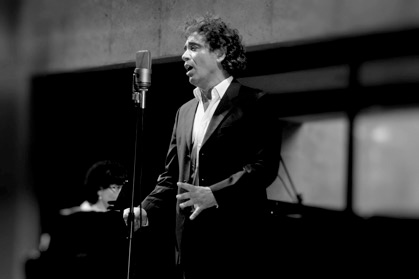
Masis Arakelian (Photo courtesy of masisarakelian.com)
On Sunday January 26, Archimandrite Yeghishe Avetisyan celebrated mass, with chorus and members of the community.
Among the 10 public events were a number of concerts; Duduk player Arayik Bartikyan from Paris performed on January 25, and on March 26, Masis Arakelian will sing Armenian art songs from the last 300 years, including works by Komitas, Khatchaturian, Sayat Nova, as well as original compositions and works by Charles Aznavour. Arakelian appeared on February 13, for an evening of Armenian fairy tales (read by Renate Raber) and music, commemorating the 150th birthday of Hovhannes Tumanian and Komitas. On May 28, to celebrate Independence Day, a concert will feature singers Yeva Egasyan and Hayk Yesayan.
Dr. Tessa Hofmann, author, human rights activist and genocide scholar, was joined by community members to host an evening to introduce Armenia on January 30, and on February 27 delivered a lecture on “The Genocide of Christians in the Ottoman Empire.” The film “Ageth: A Genocide” will be shown on March 12. For people who have not yet visited Armenia, there are experts to illustrate the natural beauty and the architectural landmarks of the country on March 5; Eduard Saroyan, director of an Armenian travel agency, speaks on “Armenia – Close to Paradise,” Dr. Andreas Goetze’s theme is sacred architecture, and art historian Ani Serobyan focuses on the khachkars.
At the concluding event children from the Giteliq Sunday school in Berlin-Charlottenburg will sing and dance under the direction of Lilit Hakobyan and Masis Arakelian, scenes from Paul Imhof’s film “A Journey through Earthly Paradise” will be shown, and guests will enjoy songs by Arakelian as well as Armenian specialties in food and drink.
Germans Adopt Armenian Digital Education Model
by Muriel Mirak-WeissbachBERLIN, FEBRUARY 27, 2020 — When German Chancellor Angela Merkel visited Armenia in August 2018, she was impressed by the innovative spirit pervading the country. Not long before her arrival, Armenia had gone through a “velvet revolution,” which reminded many Germans of their own peaceful revolution that replaced the East German Communist regime in 1989. It was not only in the political and social realm that fresh winds were blowing; also in technology, Merkel encountered creative new approaches.
The German chancellor was fascinated by the TUMO Center she visited in Gyumri. A physicist by training, Merkel marveled at the effectiveness of the original concept developed there to educate young people in computer sciences. Accompanied by the Minister for Science and Education Arayik Harutyunyan, Merkel said at the time that she “saw teenagers develop innovations while holding fast to the roots of Armenian culture. I just realized what a knowledgeable society exists in Armenia.” Due to her keen interest in the project, she discussed the possibility of opening such a center one day in Germany.
That day is now on the agenda. On February 13, during a joint press conference with Merkel in Berlin, visiting Prime Minister Nikol Pashinyan announced the opening of the first TUMO Center in Germany. He and Merkel praised their growing bilateral economic and technological cooperation, of which the TUMO project is the impressive centerpiece. Pashinyan said he was “very happy with the agreement” to set up the facility. “It is a great honor,” he said, “for us to share our advanced experience with a technology-intensive country like Germany.”
The TUMO Center for Creative Technologies, named after poet Hovhannes Tumanyan, is the brainchild of Sam and Silva Simonian, Armenian Americans originally from Beirut. The first center in Armenia appeared in the capital in 2011 and now there are three more, in Gyumri, Dilijan and Stepanakert, capital of Karabakh (Artsakh). The Simonians’ foundation has generated similar institutions in Paris and Beirut as well.
Berlin will host the first German center, which is slated to open by autumn of 2020. The contract for license and franchise was signed on January 21 between TUMO and the Kreditanstalt für Wiederaufbau (KfW), a financial institution that sponsors education as well as development projects here and abroad. Dorothee Bär, the State Minister for Digitalisation in the Chancellor’s Office, Armenian Ambassador Ashot Smbatyan, KfW Board Member Ingrid Hengster and (connected by videostream) TUMO Chariman Pegor Papazian signed the cooperation agreement in a festive ceremony.
Creative Self-Education
The TUMO Center will provide free education weekly for 1,200 youngsters between the ages of 12 and 18, who will go there after school hours. The concept developed in Armenia allows students to achieve competency in digital technologies in a creative manner. They work together in self-learning sessions and workshops, and learn programming, animation, 3-D modeling, robotics, as well as music, photography and theatre.
Young people profit by such an opportunity to acquire skills in the frontier digital technologies, after school and free of charge; this means teenagers from all family and social backgrounds can benefit equally. Such education is a plus not only “for each individual student,” Bär stated, but “also for our society and economy.” These skills are required “to shape the future of our country,” she said, adding, “I am confident that TUMO will become a similar success story as it is in Armenia.”
Dr. Hengster emphasized the significance of the KfW’s supporting a program that was created in a country with whom the credit institute already has experience in development cooperation. “That is especially exciting,” she said. “Because in the digital field the same applies: Only when we learn from one another can we face challenges and truly encounter success.” She said she hoped many more partners would be found in Germany to join the effort.
For his part, Papazian said, “The opening of a TUMO Center in Berlin is a milestone, because Germany is a forerunner in technology and engineering, and we are particularly delighted to be able to contribute to these achievements.” Armenia is well known in this technological sector, which was already very advanced at the time of the Soviet Union, and enjoys a freedom of Internet access on a par with that of France.
Alain Altinoglu Comes to Frankfurt
by Muriel Mirak-Weissbach
FRANKFURT, February 20, 2020 — The Frankfurt Radio Symphony orchestra (hr-Sinfonieorchester) will welcome Alain Altinoglu as its new music director, beginning with the 2021-2022 season. The French-Armenian musician was born in Paris in 1975 and, since completion of studies at the Conservatoire National Supérieur de Musique de Paris, has taught there, leading instruction in conducting since 2014. He has been music director of the Brussels Théâtre Royal de la Monnaie since 2016 and in 2017 had a successful debut at the Berlin Philharmonic.
A frequent quest at several opera houses worldwide, he has performed at the Metropolitan Opera in New York, the Royal Opera House Covent Garden in London, the Deutsche Oper Berlin, Bavarian State Opera in Munich and the three Parisian opera houses. He has appeared regularly at renowned music festivals in Salzburg, Bayreuth, Aix-en-Provence, and has performed with famous American orchestras, in Boston, Cleveland, Philadelphia and Chicago. He is admired for his versatility, as proficient in opera as in symphonic music.
Prior to assuming his new position, he directed the Frankfurt Radio Symphony orchestra at the Alter Oper in Frankfurt on February 12, 13 and 14, and was joined by French cellist Gautier Capucon. Among the works performed were Rimsky-Korsakov’s The Golden Cockerel, Ravel’s Daphnis et Chloé and the Cello Concerto Number 1 by Saint-Saens.
In an interview with the Hesse Radio hr2 cultural program on February 13, Altinoglu talked about his early education in music, which began at home. The family had lived in Turkey for generations; his father was a math professor, his mother a musician. Life for Armenians in Turkey was not easy, he said, and they moved from Istanbul to France. The name Altunyan had been Turkified to become Altinoglu. But his Armenian heritage, including the church, played an important role in his childhood and development. He related how his mother had played the organ in church, and how he continued after her death.
At the age of 6 or 7, he had his first encounter with symphonic music, marveling at the scores for all of Beethoven’s symphonies which his grandfather had collected. At 5, he had begun to play the violin, but “it was a catastrophe,” he said; “everyone suffered, my family, our neighbors and I.ˮ Then he started playing the piano, under the guidance of his mother, a professional, and the instrument became very special for him. At the age of 11 or 12, he said, he realized the power of music — “more music means less stupidity,ˮ he quipped. He continued his studies at the conservatory, and became an accomplished pianist.
He was still a youth when he discovered the power of the human voice, through his encounter with the mezzo-soprano Nora Gubisch, who would become his wife. He began to accompany her and the two have performed together and issued recordings. He stressed the fact that each voice is unique, a “direct way to the soul.ˮ In his career, he has worked with vocalists both in opera and in the solo (Lied, chanson) repertoire.
Although he never studied conducting formally, he read a great about it, observed conductors at work and talked to them about the art. When he was engaged with an orchestra, one day the conductor suddenly fell ill. This was the chance to try his hand at conducting, and, since he knew the score inside out, he was able to perform. Now he is a world class conductor as well as a teacher. He emphasized the importance of winning over youth to music, as the concert public is aging. He encourages school children to attend rehearsals, also with their parents, and to talk to musicians, so they can become acquainted with compositions and performance.
Altinoglu visited Armenia in 2015 and conducted the philharmonic orchestra in Yerevan, where he was impressed by the musical culture and the commitment of the musicians, who often worked under difficult conditions. Armenian is one of his several languages. He speaks it with his young son, who understands perfectly, even though he answers in French. Now, with his new position, Altinoglu will have to learn German, “perhaps with a French accent,ˮ he quipped.
Learning languages is very important, he noted. When asked whether he thought each language culture had a particular “soundˮ in its orchestras, he said he was absolutely convinced this is the case, that there is a “Frenchˮ sound and a “Germanˮ sound. In French, he finds that the strings are very transparent, and the music is more melodic, horizontal; whereas in German music the influence of Bach is most profound. He criticized the tendency in a globalized world to have all orchestras sound alike, insisting that each country, each culture, has its own characteristic sound.
Altinoglu is looking forward to his new engagement in Germany, the land of Goethe and Schiller. And, of course, Beethoven, whose 250th birthday is being celebrated throughout this year, with thousands of concerts, lectures, exhibitions, and new publications.
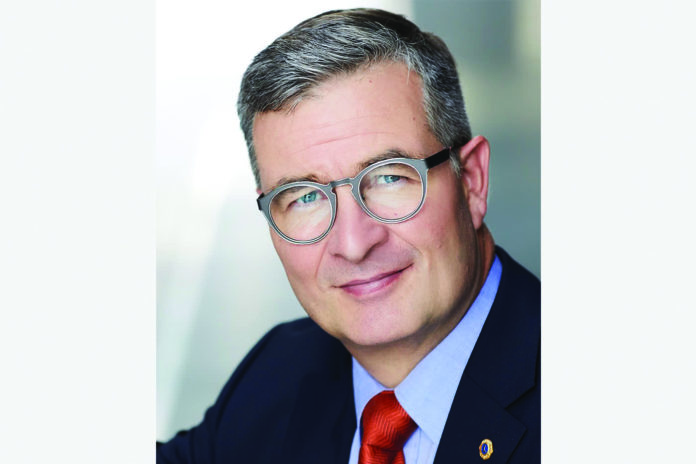
Albert Weiler (Photo from www.albert-weiler.de)
German-Armenian Forum Marks Anniversary
as Azeri Lobbyists Face Legal Trouble
by Muriel Mirak-Weissbach
FEBRUARY 6, 2020, BERLIN — On January 29, members of the German-Armenian Forum gathered in a room at the Bundestag (Parliament) for their annual meeting. The Forum, which will celebrate its fifth birthday in May, was founded upon the initiative of Bundestag member Albert Weiler (CDU), as a vehicle to promote dialogue between Germany and the Republic of Armenia at all levels. This includes exchange programs and visits of persons active in the political and economic realm, as well as teachers, academics and students. The aim is to increase knowledge and understanding about the two nations, their history, culture and current political activities.
In response to requests by members to know more about the relations between Armenia and the European Union, President Weiler dedicated his keynote speech to this theme. Reporting on the advantages of the EU-Armenia Partnership Agreement, Weiler said the dynamic was definitely positive. In April and May 2018, he said, the peaceful protests had led to a new government, which received a mandate “to shape the present and future of the country for the well-being of the Armenian people.” Germans have displayed special interest in the foreign policy course the new regime would follow and are pleased to see “the enormous value placed on cooperation with the EU.” Weiler expressed his conviction that support for Armenia’s reform course will continue.
Reviewing the past years’ progress, Weiler noted that “on November 24, 2017 the in-depth and comprehensive Partnership Agreement between Armenia and the European Union was signed in Brussels, a document that defines the future of our cooperation.” The Bundestag presented a bill for its ratification, which was debated and passed by a vast majority on April 4, 2019. After President Frank-Walter Steinmeier and Foreign Minister Heiko Maas signed the bill, it was officially ratified in August.
Weiler characterized the agreement as a “complex document,” in that it maintains the substance of an earlier association agreement, but excludes a free trade zone, due to Armenia’s membership in the Eurasian Economic Union. And yet a closer relationship to the EU’s system of norms and regulations should ensue in the interest of enhancing trade and investments. Fundamentally, Weiler said, it is a matter of providing support for Armenia’s sovereignty, its economic and social transformation and new political orientation based on democratic values, “securing universal human rights and individual freedom, supporting civil society, and strengthening the rule of law, separation of powers and representative democracy.”
Closer relations with the EU “means at the same time stable and peaceful regional cooperation.” Weiler noted Germany’s efforts at enhancing preconditions for this, by demanding open borders and good neighborly relations. He placed special emphasis on the commitment shared by Germany and Armenia to upholding existing formats for conflict resolution; for the EU these are the Organization for Security and Cooperation in Europe (OSCE) and the co-chairmen of the Minsk Group, dealing with the Nagorno-Karabakh conflict. Another important point he made was that the EU can intensify collaboration with countries that have strong economic and political ties to the Russian Federation; nations have the sovereign right to shape their relations to the EU, and regional associations are not aimed against any other country.
It is in economic and trade relations that Germany and Armenia have made significant progress. As Weiler reported, bilateral trade in 2018 grew 30 percent over the previous year, to 344.5 million euros. The Armenian government’s pledge to introduce economic reforms and fight corruption will further this positive trend.
Weiler concluded his remarks on an optimistic note; having seen how the Forum has succeeded in facilitating dialogue, not only to enhance economic ties, but also to make “Armenia better known and beloved in Germany,” he expressed his confidence that the EU-Armenia relationship will prosper.
Azerbaijan Agent in the Bundestag?
It was certainly a coincidence, but not without irony. Just as members of the German-Armenian Forum were discussing ways and means of building more bridges to Armenia, another political figure, this one a dedicated adversary of Armenia, was coming under legal pressure on suspicion of corruption. Karin Strenz has been a member of the Bundestag for the CDU since 2009 and chaired the German-South Caucasus Parliamentary Group, a group whose deputy chairman is Albert Weiler. When Chancellor Angela Merkel toured the Caucasus in 2018, visiting Georgia, Armenia and Azerbaijan, she had a delegation including parliamentarians with her. Weiler was one of them, but Azerbaijan refused him a visa, as an “undesirable person.”
Karin Strenz has been a most desirable person, working indefatigably as a pro-Azerbaijan lobbyist in the German Bundestag as well as in the Parliamentary Assembly of the Council of Europe (PACE). In that body, she was the only German representative in 2015 to vote against a resolution demanding the liberation of political prisoners in Azerbaijan. Serving on a commission of election observers, she issued her judgment that they were democratic. And she neglected to report that in 2014 and 2015 she received funds from Azerbaijan through a company Line M-Trade, a financial front for paying lobbyists. In 2017 her party pulled her out of the Council of Europe and she was banned for life from PACE. In 2019 the Bundestag issued an official reprimand because she had failed to report the outside income, and calls for her resignation became louder.
The Armenische-Deutsche-Korrespondenz, the journal of the German-Armenian Society (DAG), published several reports documenting her shady dealings with Baku. Among them was her curious initiative in 2017 to bring together three parliamentarians each from Armenia, Azerbaijan and then-Organization for Security and Cooperation in Europe (OSCE) chair Austria, on neutral ground, to deal with the Nagorno-Karabakh conflict. Armenia was not informed, nor was the German government or Bundestag, nor were the competent authorities in the Minsk Group! (In this light, one realizes better why Albert Weiler underlined the importance of the established formats for conflict resolution.)
Now it appears Strenz may be in serious trouble. On January 30 (a day after the German-Armenian Forum’s membership meeting), the Bundestag voted to lift her parliamentary immunity on request of the Frankfurt state attorney’s office, on suspicion of corruption in connection with Azerbaijan. According to wire reports, a hundred police and federal criminal police (BKA) conducted raids on her Bundestag office, her home, as well as other residences, offices and legal practices in three German federal states as well as a locality in Belgium. The second prime suspect, whose residence and office were raided, is former CSU Parliamentarian Eduard Lintner, a lobbyist for Azerbaijan. The Line M-Trade firm belongs to Lintner. The suspicion against Lintner is that he received about 4 million euros from Azerbaijan between 2008 and 2016, through fake firms, and paid off PACE politicians to do pro-Azerbaijan lobby work. A third suspect may be charged with money laundering.
It was a coincidence, but indeed, with a touch of irony.
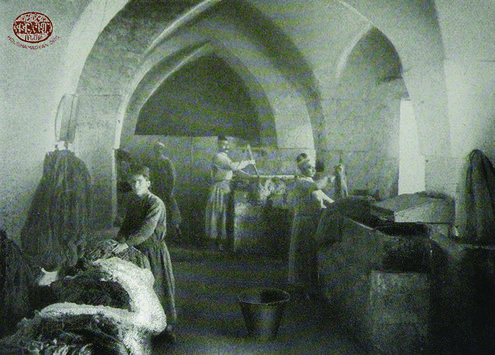
Armenian workers in Urfa (Source: Paul Rohrbach, Armenia , Stuttgart, 1919; photo courtesy of Houshamadyan)
Armenian Architecture and Genocide
by Muriel Mirak-Weissbach
OSNABRÜCK, Germany, January 2, 2020 — The aim of the Young Turk leaders in organizing the genocide was to rid the country of the Armenians, as a population and a culture. They determined to “Turkify” the land, cleanse it ethnically of the Christian minorities, and erase, to the extent possible, all traces of their existence. Among the myths created at the time of the founding of the Turkish Republic in 1923, was the tale that the Armenians had not inhabited those lands; they had “always been Turkish.”
In 2011, I had the opportunity to travel with my brother and my husband to Turkey, as part of a group of Armenians from America. Our guide was the indefatigable Armen Aroyan of California, who has accompanied groups of “pilgrims” to the lands of historic Western Armenia for over a quarter century. We were hoping to rediscover the villages where our parents had lived, in the Arapkir province, and were fortunate enough to find them. But signs of Armenian life were nowhere to be found. In other cities and towns we visited, like Kars, we found the remains of Armenian churches turned into mosques; in other localities they had become museums, still others, stables where animals lived.
Yet, the evidence of Armenian life and culture could not be totally eradicated; the very stones, albeit in ruins, could bear testimony to the story of the people who once lived there, with their homes, their shops and factories, their schools and churches—above all, churches, chapels and monasteries. Ani, the ancient capital of an Armenian kingdom, with its legendary 1001 churches, is the most eloquent example. What was most painful, as I wrote in a report on our visit, was to witness the attempt to eradicate memory itself. (See https://mirrorspectator.com/2011/07/29/opinion-the-stones-will-cry-out/)
A Story of Cultural Genocide
Now Germans have the opportunity to make a similar journey through parts of historic Armenia, albeit not in person, but through images and words. On December 5, an exhibition opened in Osnabrück, which documents precisely this history. “1915-2015. Armenische Architektur und Genozid” is the title of the exhibition organized by the Erich Maria Remarque-Friedenszentrum (Peace Center) in cooperation with the German-Armenian Society (DAG). The venue of the show is particularly significant. The Erich Maria Remarque Peace Center, founded in 1996 by the city and university of Osnabrück, is dedicated to the life and works of the author best known for his “All Quiet on the Western Front.” The center has an archive open to researchers, and organizes regular activities including exhibitions, lectures, film showings and symposia. Among them have been two events on Armin T. Wegner. For Dr. Raffi Kantian, president of the DAG, it is especially appropriate to hold the exhibition at this center; he stressed that whereas Remarque in his world famous book, “described the horrors of World War I on the Western front,” the exhibition presents the “consequences of the extermination of the Armenians on the Eastern front.”
After greetings by Dr. Thomas F. Schneider, from the Osnabrück University and an opening address by Mayor Birgit Strangmann, Dr. Kantian introduced the large audience to the events of 1915 and the theme of the exhibition, which will run until January 19, 2020.
The question that the display poses and seeks to illustrate, is: “What impact has the genocide had on the cultural legacy of the Armenians in Turkey?” Twenty-two huge panels (six-feet high) present in text and photographs the main stations in the drama: first, Armenian life before 1915 is depicted, in its multifaceted forms, through family photos, as well as scenes of towns and cities where Armenians lived and worked, studied and prayed. Accompanying the pictures are texts providing background information for visitors who may be unfamiliar with the subject.
The deportations and massacres are illustrated, with explanatory texts based on accounts by American Ambassador Henry Morgenthau and survivor Pailadzo Captanian. The next section depicts the “Destruction of Armenian Lebensraum,” literally, the elimination of the physical basis for continued existence. Here, as we saw on our travels through eastern Turkey in 2011, entire communities were wiped out, and with them, all the physical structures, whether homes or workplaces, buildings for manufacture or commerce, and, of course, the schools and places of worship. “Before” and “After” photos of the same location, for example in Sivas, show the complete replacement of Armenian architecture by modern shopping centers.
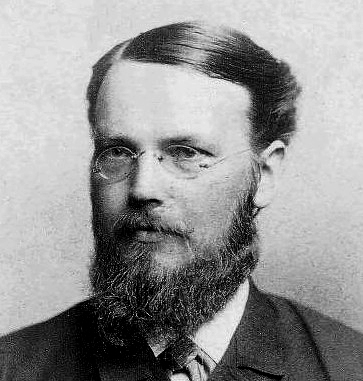
Johannes Lepsius (Photo courtesy of Wikipedia)
The fate of the cloisters and churches deserves special treatment. Here the panels show historic photographs of the majestic churches before and after the destruction, Surp Garabed in Mush, for example. The image that symbolizes the tragedy and stands as emblematic for the entire exhibition, is a 1900 photograph of the magnificent Khtzkonk monastery, a complex of five edifices in Tekor, which was blown up in 1964, leaving one lonely church standing in ruins against a devastated landscape. Other monasteries, a handout for the exhibition explains, “were razed (Karmravor Monastery Surp Asdvadsadsin), destroyed and used as building material for houses and mosques (Surp Garabed in Mush).” Worse still, some churches were degraded to function as barns, stalls, storage rooms or even prisons.
The exhibition highlights the Mush-Sasun-Van region for the important role it plays in Armenian history. As early as the fifth century, monasteries were vibrant centers of cultural activity, which produced valuable manuscripts and miniatures; literary and spiritual life flourished in the region which boasted up to 250 churches, cloisters (as on the island of Lim) and fortresses among other architectural monuments. One exception to the rule of destruction is the Surp Khach on the island of Achtamar, a jewel of Armenian church architecture which has escaped ruin and even been renovated. Though reclassified as a museum and allowed only one church service a year, this majestic structure, with its unique bas relief sculptures, is a treasure to behold.
Although many cities through the genocide were deprived of their Armenian character, some, like Sivas, managed to maintain traces of community life. Here, the exhibition presents the example of the Shahinyan family as testimony to the city’s history. The respected family hails from a member of the first Ottoman parliament in 1877, Agop Shahinyan; many photographs record images of his family and their home (built in 1877), officially recognized as an outstanding example of Ottoman architecture – without mention of its Armenian origins.
What’s In a Name?
It was a deliberate policy, pursued by the Turkish authorities since the genocide, to eradicate the Armenian identity of the land, its history and its culture, as embodied in its architecture. Thus, the very name “Armenian” was erased from written records, whether they be texts for school children or place names in geographical locations or maps. In Kars or Ani, if reference is made to the Bagratids, there is no hint that the name might refer to Armenians.
Urfa is yet another example of a city deprived of its people and identity. Once it was home to 38,000 Armenians before the genocide; skilled craftsmen who worked as goldsmiths and carpet weavers, they lived in a community with functioning schools and an active Protestant parish. During the Hamidian massacres, 3,000 Armenians who had sought refuge in their church, were burned to death in the Surp Asdvadsadsin. This was the city where the German humanitarian and pastor Johannes Lepsius set up his rug factory, to provide refuge and employment to Armenian orphans. Today, one learns at the exhibition, the location hosts a hotel.
This important and timely exhibition was made possible through the efforts of many persons and institutions, among them, the Armenische Unternehmerverband e.V., Hasmik Hagopian, the two sponsoring associations, and a long list of individuals and organizations, which made the photographic material available.
(Material for this article has been taken from an article by Giorgio Bavaj and Alfrant Bedrosian, “1915-2015. Armenische Architektur und Genozid. Eine Ausstellung.” The article, which is a handout for the exhibition, has been published on the website www.remarque.uni-osnabrueck.de/aktuell.html).
Armenian Research Center
Established in the Polish Academy of Sciences
By Armenuhi Drost-Abgarjan
KRAKOW, Poland — As a gift to the Mesrob Center on its jubilee, Prof. Armenuhi Drost-Abgarjan received an invitation from the president of the Polish Academy of Arts and Sciences, Prof. Jan Ostrowski, to participate in the academic board of the Research Center for Armenian Culture, which was formally inaugurated at the Collegium Majus (Jagellon University Kraków) on September 21.
The establishment of the center is the result of years of work by university professors Andrzej Pisowisz and Krzysztof Stopka, who have dealt with the Armenian language and cultural legacy in Poland, in the context of their studies in History and Indo-Germanic Philology.
The center was set up on the initiative of Minister of Science Dr. Jaroslaw Gowin, with the aim of conducting research into the history of Polish Armenians in their cultural specificity as well as in relation to the Armenian Diaspora in central and eastern Europe.
The inauguration of the new center began following a visit to the historic Czartoryski Library, where Armenian manuscripts and early prints are also preserved. The international guests from Hungary, Rumania, Russia, Switzerland, Italy and Germany then gathered in the library of the Collegium Majus, where Stopka, the designated director of the research center, gave his welcoming speech.
Prof. Andrzej Zieba introduced the program and the three staff members of the new research center. The keynotes were delivered by Dr. Harutyun Marutyan, director of the Genocide Museum in Yerevan, and Vahan Vardapet Ohanian, representative of the Mekhitarist Congregation in Venice.
(Translated from German by Muriel Mirak-Weissbach)
Komitas Celebrated in Berlin and Halle
By Armenuhi Drost-Abarjan
BERLIN — The Mesrob Armenian Studies Center at the Martin Luther University in Halle-Wittenberg celebrated its 20th anniversary in the academic year 2018-2019 with three international conferences, an exhibition on Levon I (see https://mirrorspectator.com/2019/05/30/levon-i-and-the-kingdom-of-cilicia/) and two concerts. The festivities concluded in October with an academic conference on “Komitas and his Legacy” on the occasion of the 150th birthday of the Armenian musicologist and composer, a symbolic figure for German-Armenian relations.
The international conference-festival titled “Komitas and his Legacy” on October 8-10 drew 50 guests and speakers from the US, Canada, Armenia, Russia, Ukraine, Croatia, France and Italy. It was a cooperative effort of the Komitas Museum-Institute in Yerevan (Dr. Nikolay Kostandyan/ Prof. Mher Navoyan), the Humboldt University in Berlin (Prof. Sebastian Klotz) and the State Library in Berlin (Meliné Pehlivanian) and took place in Berlin and in Halle (Prof. Klaus Neumann/ Prof. Armenuhi Drost-Abgarjan) from October 8 to 10. In the banquet halls of the Humboldt University and the Halle University, high level representatives from the political, cultural and scientific communities in Germany and Armenia participated.
Armenia’s Ambassador to Germany Ashot Smbatyan and the priest of the Armenian Community in Germany Rev. Yeghishe Avetisyan opened the festive event by laying a wreath at the memorial plaque for Komitas at his alma mater in Berlin.
The aim of the conference was to take a new look at Komitas’s life work, by shedding light on those areas in which his work was innovative, including field research, musical ethnology, folk music, medieval church music, the art of composition and liturgy. In the course of the event, aspects of Armenian music were also considered in the context of other musical traditions. The proceedings of the conference will appear in an anthology in Yerevan.
Dr. Nikolay Kostandyan
The program included the official opening of a traveling exhibition on Komitas, at the State Library in Berlin. A concert featuring works by Komitas was sponsored by the German Federal Minister of Foreign Affairs Heiko Maas and the Foreign Minister of the Republic of Armenia Zohrab Mnatsakanyan. Prominent artists who performed were Hasmik Papyan (Vienna), Sergei Khachatryan (Eschborn), Hayk Sukiasyan (Madrid) and the Berlin vocal ensemble under the direction of Prof. Kristian Commichau (Potsdam).
Historian Claude Mutafian (Paris) and psychologist Dr. Rita Soulahian-Kuyumjian (Montreal) chaired a round table discussion on the theme of “Art in Times of Repression.” They considered various hypotheses regarding Komitas’s “silencing” (loss of speech) as well as the therapeutic treatments available to him; a survivor of the Genocide, the artist and scientist suffered a mental breakdown and, for twenty years of his life, was no longer able or willing to exert his creative capacities.
The conference proceedings in Halle (where Komitas’s teacher Prof. Oskar Fleischer had earned his doctorate) took place on October 9, in an emergency situation due to a terrorist attack against the Jewish synagogue in the city that day. Although complex organizational measures were required to guarantee the security of the international guests, among them the Armenian Minister for Education, Science, Culture and Sports Arayik Harutyunyan, the conference and the final concert in the Händel House, with works by Komitass and his contemporaries, went smoothly and were very successful. Particularly impressive was the performance of the famous Komitas interpreter Prof. Ruben Dalibaltayan (Zagreb), whose musical fireworks were a worthy tribute to the celebrated Armenian composer.
In her welcoming address, Prof. Valentina Calzolari (Geneva), President of the International Association for Armenian Studies (AIEA), said:
“From abroad, I would like to express my heartiest greetings to all participants of this conference, some of whom have travelled from afar, as well as the organizers. I am convinced that this conference, with its modest title, “Komitas and his Legacy,” will lend a new interdisciplinary perspective to many aspects of Komitas’s life and activity, by locating his rich, multifaceted work in its historical and cultural context, and by highlighting his links to Europe and especially Germany, as well as the Ottoman Empire…
“Since 1998 the Mesrop Center has developed into a privileged place for study of Armenian literature and history, especially literature and religious history in relation to other communities in eastern Christendom. I would like to express my hearty congratulations to Prof. Drost-Abgarjan for this important development that she has secured for the center for the years to come. As the only center for Armenian studies in Germany, the Mesrop Armenian Studies Center plays key role in the field of Armenology. I wish the Center a long life, many further activities and international cooperative efforts, in addition to those it has already abundantly nurtured.
“The International Association for Armenian Studies, which I have the honor to chair, expresses special thanks to Prof. Drost-Abgarjan and her team for the organization of the next AIEA general conference, which will take place next year, September 2020 in Halle.”
(This text was kindly made available by the author, who is the director of the Mesrob Armenian Studies Center at the Martin Luther University in Halle-Wittenberg. A series of reports on the activities of the Center, including the item on the new center in Poland, will appear in the upcoming issue of the ADK (Armenische-Deutsche-Korrespondenz), the journal of the German-Armenian Society. The free translation from the original German is by Muriel Mirak-Weissbach.)
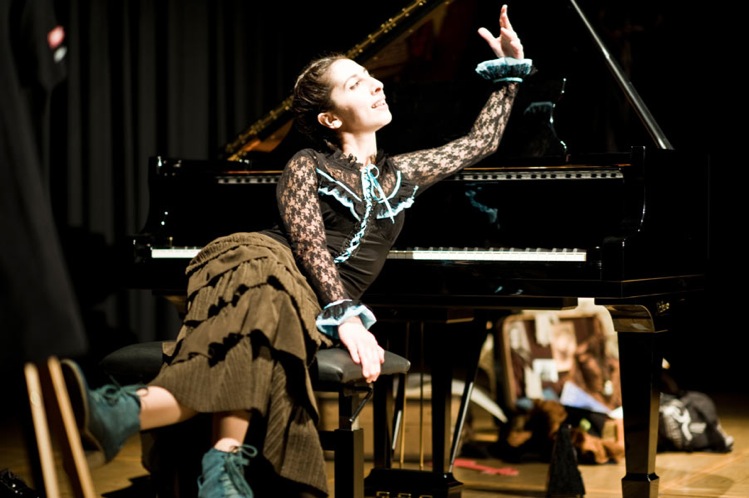
Lusine Khachatryan as Clara Wieck
Armenian Pianist Celebrates the Schumanns
by Muriel Mirak-WeissbachFRANKFURT, November 21, 2019 — “My name is Clara, Clara Wieck.” She stands in center stage, her hands clasped, dressed in an elegant blouse and long skirt, her dark hair pulled back to accentuate the fine features of her oval face. She greets the audience with a bright, wide smile and rushes to the grand piano, takes her place, raises her hands gracefully and plays a piece by Robert Schumann, her beloved Robert, whom she will marry. She is the 18-year-old Clara Wieck playing Schumann. She is Lusine Khachatryan playing Clara Wieck playing Robert Schumann.
This year Germany celebrates the 200th birthday of Clara Schumann, wife of the great musician, and herself not only a brilliant pianist but an accomplished composer. Lusine Khachatryan is an Armenian pianist, who has created a unique art form, the “piano-theatre,” which consist of a dramatic development on stage, combined with piano music. Her first work (2012) was inspired by Friedrich Schiller’s drama “Maria Stuart,” and was followed a year later by “Chopin: The piano is my second self.” That same year she composed the Schumann piece, and in 2015, “Nostalgia,” which deals with the Armenian soul and culture.
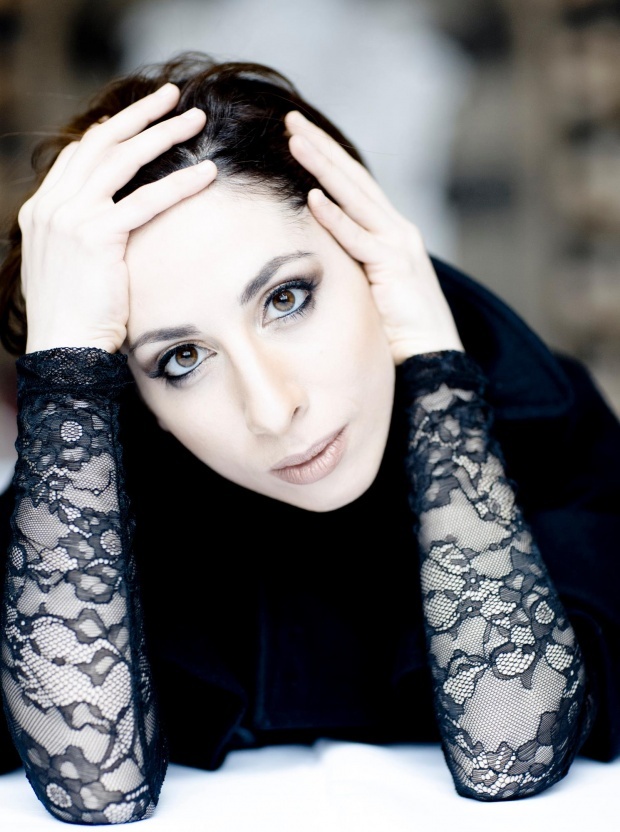
Lusine Khachatryan
In her recent appearances on the German stage in Frankfurt and Potsdam, she thrilled audiences with her presentation of Clara Wieck, (who had taught at the Frankfurt conservatory). She depicts the young girl who is determined to follow her own dreams, despite her father’s opposition; she dramatizes the conflict with her father (who was both teacher and mentor), and her love for the young composer Robert, in a series of monologues, delivered with dramatic power and playful humor; she prances about, using creative stage business with a plethora of props — a suitcase with clothing; a packet of letters which she clutches to her chest, and swaying, murmurs, “a letter from my husband, my beloved Robert;” scores of music, among them a volume of études by Czerny — and returns again and again (amid acrobatics) to the piano, on which she performs selections from works that Schumann composed prior to their marriage.
She opened with Variations on the name Abegg Op. 1 (1829-1830) and followed with selections out of Carneval Op. 9. Always interspersed with short passages telling her story, she played 5 of the 8 Phantasiestücke (Fantasy pieces) Op. 12 (1836-1837). Following a brief intermission, she performed the entire Carneval (1833 and Winter 1834-1835), a virtuoso composition which she presented with technical mastery and mature expression. It was a wonderful tribute to Clara Wieck, who indeed performed Schumann’s works in piano tours throughout Europe and was known as one of the most accomplished pianists of her time. Musicians like Paganini, Chopin and Brahms expressed their admiration for her remarkable achievements. The Schumanns encouraged the younger Brahms, some of whose compositions were inspired by Clara. Now on the occasion of her birthday, her own extraordinary compositions have gained even wider attention.
Khachatryan comes from a musical family, and, like Clara, began playing the piano at home, under the guidance of her mother Irina Hovhannisyan and father Vladimir Khachatryan, who are both concert pianists and teachers. Her brother, Sergey Khachatryan is a world class violinist, with whom she regularly performs; they have released several CD’s, among them, the complete sonatas for piano and violin by Johannes Brahms (2013) and “My Armenia,” featuring works by Armenian composers (2015). If Lusine was the author, director, actress and pianist in her musical-theatrical creation, her brother Sergey provided the lighting, while her parents were on hand to enjoy the performance. The family lives and works in Germany.
She studied at the Karlsruhe Music Academy from 2001 to 2008, and graduated with a double degree in piano and chamber music. As a soloist, she has won many prizes and has performed in leading concert halls throughout the world, including at several famous music festivals in Europe and the US. She also appears with renowned chamber and symphony orchestras.
The New York Times pronounced her as “a superb pianist, with a big sound and a fiery technique…”
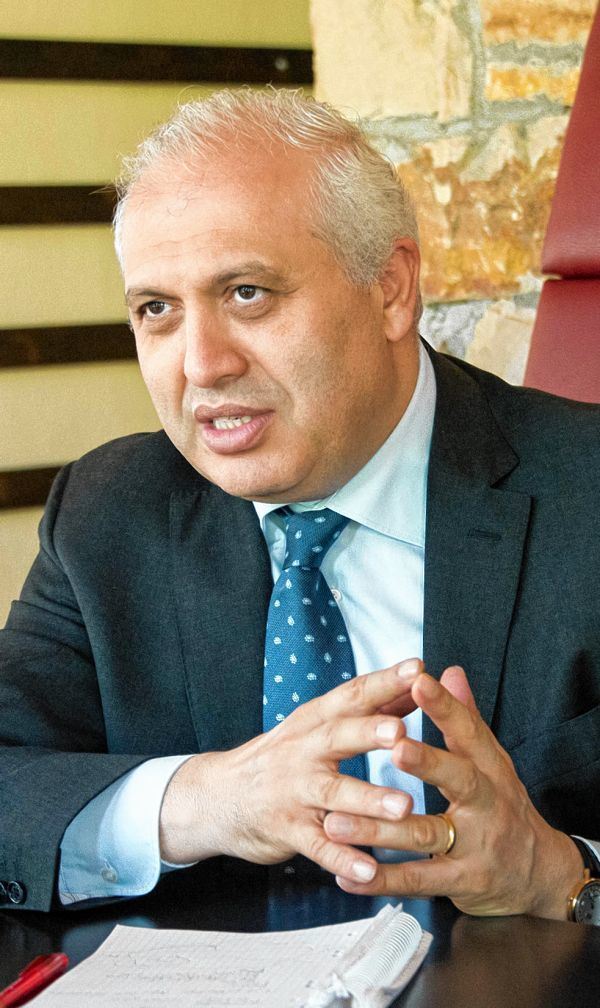
Ambassador Smbatyan
Germans in Dialogue with Armenia
by Muriel Mirak-WeissbachBENSHEIM, Germany, November 29, 2019 — When the German-Armenian Forum came into being in 2015, the founding members stressed that its purpose was to help Germans and Armenians become acquainted, and to learn about their respective history, culture and country. CDU parliamentarian Albert Weiler launched the initiative with the idea that people from the two countries should meet at all levels — from political leaders, to legislators, university students, pupils, musicians, artists, people from all walks of life.
During the founding meeting four years ago in a room of the Bundestag (Parliament), the initiators formulated the new association’s statute and voted up a presidium. According to the press release, the members of this body were “individuals familiar with issues related to the southern Caucasus, and pursue the aim of promoting German-Armenian relations at various levels. The Forum should support Armenia in its democratic development, strengthen economic relations, support cultural and scientific exchange and build new bridges between the two societies.” They pledged to organize conferences, seminars, workshops and working groups, and cooperate with existing organizations which pursue similar aims.
Weiler had visited Armenia in 2014, and the experience left a lasting impression on him. “Armenia is a country with a very ancient Christian tradition, which since its independence in 1991 has charted a democratic path, which deserves support,” he said at the founding meeting. “True, Armenia lies in a difficult geographical position, but it has an enormous spiritual and economic development potential. We would like to exhaust and further develop these synergetic possibilities.”
Since its inception, the Forum has lived up to its pledge, actively promoting dialogue and exchange with Armenia at various levels. This year, it has been organizing events on the local level under the rubric, “Dialogue with Armenia,“ engaging students in their schools. On November 19 one such meeting took place at the Goethe Lyceum in Bensheim, which is the congressional district of the Forum’s vice-president Till Mansmann. There and in collateral meetings in the Hesse region, Mansmann was joined by the honorary consul for the Republic of Armenia, Dr. Brian Fera, and the Armenian ambassador from Berlin, Ashot Smbatyan.
Smbatyan delivered a lecture to the students about Armenia, its culture and history, and then took questions. In the course of the dialogue, proposals took shape for longer-term projects to engage students as well as teachers in an exchange program.
Following the school visit, the group visited City Hall with a local representative Philipp-Otto Vock and the City Councillor Adil Oyan. The discussion centered on the positive effects of city partnerships and how they contribute to mutual understanding and cultural exchange. To conclude their tour, the group met with the chairman of a firm promoting regional economic development (Wirtschaftsförderung Bergstrasse), Dr. Matthias Zürker and discussed economic perspectives locally and in Armenia.
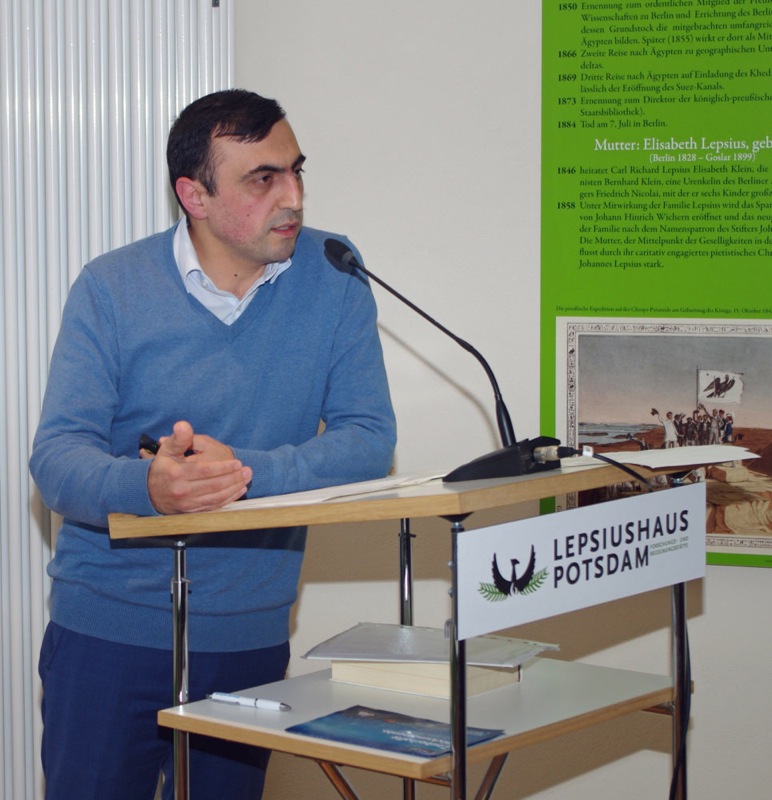
Dr. Hayk Martirosyan (Photo courtesy of Ulrich Rosenau, Lepsiushaus, Potsdam)
Memoirs of an Orphan
by Muriel Mirak-WeissbachPOTSDAM, Germany, November 7, 2019 — In the extensive literature of the Armenian Genocide, memoirs of single survivors play a special role. Each story is different, and yet all share certain characteristics; the trauma of the events, separation from loved ones, uncertainty and fear regarding the future. Among the survivors are many whose names have gone down in history. At the same time, there were hundreds of thousands of orphans, many of whom ended up in Turkish families, and their identities were lost in time. The more fortunate managed to retain their identities as Armenians, and to find new homes abroad.
Heinrich Melidonian was one such orphan, who was born in the Ottoman Empire and ended up in Germany and France. Dr. Hayk Martirosyan has reconstructed his fascinating story on the basis of the young man’s writings and of research into archives in Germany. Martirosyan, who is a scientific collaborator at the Lepsiushaus in Potsdam, presented the results of his efforts in a lecture there on October 31.
Heinrich Melidonian, born in 1901, was given that name on the request of Sister Paula Schäfer and baptized by the Protestant Father Richard Brunnemann. The infant had been taken in by the orphanage of the German Hülfsbund für Christliches Liebeswerk im Orient (DHCLO), a relief organization in Marash. Thanks to donations given by “foster” parents in Germany Deacon Otto Clarenbach and Pastor Kuhlo, Heinrich could live and receive medical care in the orphanage until 1915.
The Germans had sent up hospitals, orphanages and schools in various Armenian villages during the Hamidian massacres (1894-1896), a few of which survived the genocide that began in 1915. The Marash orphanage was one of them. Despite the support it received from the German Consul in Aleppo, Walter Rössler, it came under pressure from the Ottoman authorities and had to give the children to relatives, if they had any, or to Armenian families who received financial support from the orphanage. Heinrich was one of these so-called “Kostenkinder” and lived with a certain widow Turwand for a while. Later, when he was allowed back into the orphanage, deportation orders came down; he was sent off with other youngsters to work on the Baghdad railway, but, sick with malaria, had to be sent back. In this way, he survived the massacres and in late 1918 began an odyssey which took him to Cilicia, and then Adana and beyond. Thanks to his years in Marash, where he learned German, Turkish and English, he was better equipped than others to seek work, which he found as a translator. In 1920, he accompanied children under the care of Near East Relief who were evacuated from Adana to Cyprus. There he was able to attend the American College, before going with the children on to Tarsus, where he studied at the American St. Paul’s college.
Again, due to political events, he had to flee, this time to Smyrna (Izmir). When their ship was stopped and the Turks hauled passengers out to kill them, he and other children managed to survive by hiding. “I promised Him,” Melidonian later wrote, “that I would devote my entire life to Him, if he saved me from this mortal danger.” In Smyrna he was able to study at the American college and in 1922 was confirmed in the Protestant church. During the massacres in Smyrna in September 1922, he and other students were arrested and released only in May 1923, in the context of negotiations of the Lausanne Treaty. From there he travelled to Greece, then to France, from there to England, then Canada, and when not allowed to settle there, returned to France. In 1927, thanks to the mediation of his “foster” parents, he was admitted to the Johanneum Protestant School in Wuppertal-Barmen, then entered a course at the Karlshöhe Diaconate Institute. He became a deacon but was not allowed to work as a pastor in Germany. He collaborated with the YMCA in various cities.
In the late 1930s Melidonian began to write about his experiences. Past, … but Not Forgotten! Memoirs and Experiences of an Armenian Orphan and the Missionary Station at Marash in Asian Turkey was one book; By Dangerous Cliffs was another; and Light after Darkness yet another. In these works, Martirosyan said, “he described his wanderings through the Ottoman Empire and the difficult life of the orphan and prisoner that he led. These books,” he added, “are still very important today as memoirs of an eyewitness during the genocide with very detailed descriptions and images.”
Melidonian also published a book reporting on a visit to the Holy Land, and spoke about his experiences in various cities in Germany. In 1939 he published an intriguing work, titled, Discussions with an Armenian Christian, in which he hoped to make Armenians in Germany known. Martirosyan said that the author posed questions, like, “Who are the Armenians?”, “Where is Armenia?”, “Are the Armenians Christians?”, “Why were the Armenians persecuted?” Although he did not succeed in becoming a German citizen, he contributed to making his people and the story of their plight known to the German public.
Martirosyan concluded by saying that Melidonian is one of the few orphans whose life story is documented in at least five European archives. “Hundreds of thousands of Armenian orphans died,” he said, “were killed, or disappeared without a trace. Melidonian’s example shows how much effort, and often also luck, one needs, how many disappointments one has to overcome and how hard one has to fight, to be able to stay alive.”
Dr. Rolf Hosfeld, Academic Director Lepsiushaus (Photo courtesy of Ulrich Rosenau)